The manosphere, misogyny and sexism
The news in the UK on October 30th 2026 largely revolved around the manosphere with some interesting headlines such as Manosphere ‘as bad as smoking’ and Manosphere content ‘best understood’ like smoking ads for children…
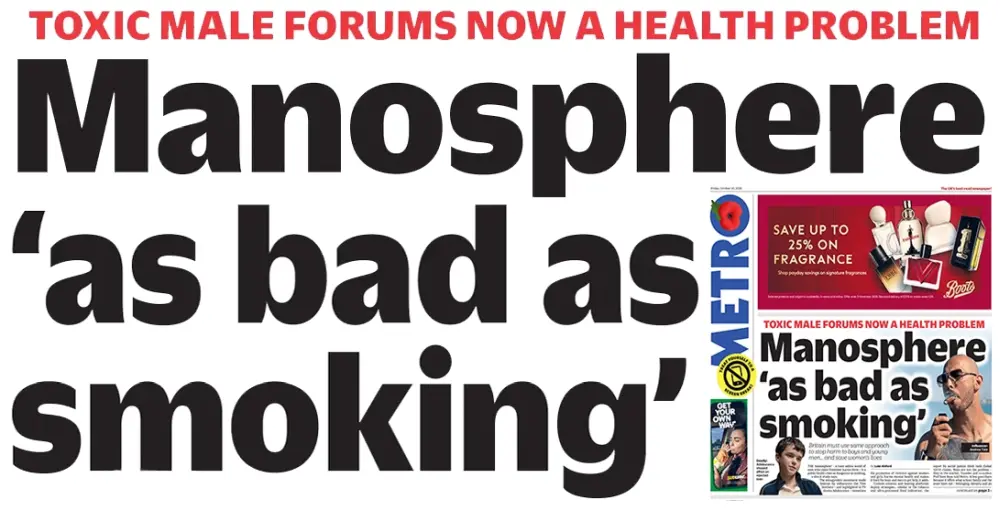
Metro: Manosphere as bad as smoking.
These, focusing on the manosphere, misogyny, sexism, violence against women and girls, amid a growing response from governments, researchers and campaigners. One particularly significant development today is the growing argument among academics that online misogyny should be treated as a public health issue – rather than simply being a problem of individual attitudes or offensive social media posts.
Morning Star: Manosphere content ‘best understood’ like smoking ads for children, Lancet paper says.
The Lancet: Reframing the manosphere – a public health response to a commercial ecosystem.
The report published in The Lancet – written by Sarah J Hawkes and Kent Buse and entitled ‘Reframing the manosphere: a public health response to a commercial ecosystem’ – is calling for the manosphere to be treated as a public health problem. The researchers argue online communities are promoting male grievance, hostility towards feminism and misogynistic attitudes are contributing to serious harms. The researchers’ key arguments include:
- Social media and content creators can financially benefit from promoting outrage, resentment and antagonism towards women.
- Boys and young men can be drawn into these communities through loneliness, insecurity, isolation and a desire for belonging.
- Misogynistic narratives can normalise hostility towards women and girls.
- These environments can also discourage men from seeking help with their own mental health.
The researchers compare the commercial strategies with those historically used by the tobacco industry – making harmful behaviour appear normal while shifting responsibility onto individuals. Hawkes and Buse stress that boys and men themselves are not the problem and argue that society needs to offer young men positive role models, support, belonging and opportunities. The report clearly denotes a shift in how society approaches online misogyny.
Sources: Sky News; The Guardian.
UK government announces £15 million for tackling misogyny

The UK government’s £15 million Misogyny Prevention Fund will support organisations working to challenge sexism and misogyny in these areas:
- Schools and educational settings.
- Workplaces.Public spaces.
- Young people’s social environments.
Proposed activities include mentoring, workplace training and public awareness campaigns. The announcement comes amid growing concern about the influence of online manosphere personalities on boys and young men. There is also an existing separate £20 million package intended to help schools address misogynistic influences, online misinformation and relationship issues.
The government is increasingly recognising that misogyny cannot be tackled solely by supporting women after abuse has happened. Prevention, education and changing attitudes among boys and men also need attention.
Sources: The UK Parliament; The Guardian.
Stronger workplace protections against sexual harassment come into force
On October 30, 2026, the UK government implemented new job safeguards against sexual harassment. Accordingly the modifications will improve protection for employees harassed by clients and consumers. Employers’ obligations to prevent harassment will be reinforced. The Employment Rights Act’s measures will benefit over 18 million workers. Almost 25% of adult victims of sexual harassment say it occurs at work. The Act is an effort to go beyond merely handling complaints following occurrences of work place harassment. Employers are expected to take preventative action and address risks to their staff.
Source: UK Government.
Social media companies lose legal challenge over online safety information
Meta, TikTok and X have lost a High Court challenge against information requests made by Ofcom, the UK’s communications regulator. 1
The requests concern information about content moderation, including how many posts are removed or restricted and how many users encounter harmful material. The companies had challenged the regulator’s demands, arguing that they were disproportionate. The court rejected their arguments. This is significant because it strengthens Ofcom’s ability to obtain information about how platforms manage harmful content under the Online Safety Act.
The UK government has not confirmed which platforms will be affected by the ban but it is expected to cover the same sites as in Australia. Those are: Facebook, Instagram, Kick, Reddit, Snapchat, Threads, TikTok, Twitch, X and YouTube. (Guardian)
There’s concerns the ban will disenfranchise teenagers between 16-17 years old. When bans were being considered in 2013, it was said that technology would not work very well at blocking abusers. Better education and awareness was deemed more effective – and ought to be part of education as well as advertising and newspapers. Like many things, the digital route seems considerably attractive but as observers have pointed out, its laden with pitfalls including vulnerability to cyber hacking and data breaches 2 – and the UK government 3 has not been impervious to these sort of things.
Not only that, in the experience of Australia, there has been a huge number of fake pop ups claiming to do age and ID verification, and some have got caught out in giving their details to bad actors. Warnings were given on this prior to the country’s implementation of digital ID. 4 There’s also a rise in fake IDs being sold to teenagers. 5 The Australian Government’s acknowledged such threats from bad actors and has advice on how to deal with this. 6
It must be said that the attempts at online identification are quite patently the wrong way to go about things. The concern is not even more digital surveillance as well as bad actors thrown in the mix – but that far better awareness and education is better. Certainly sites that have the potential to do harm ought to have a demarcation where digital ID is needed but otherwise the onus is that any massively increased digital surveillance by the state amounts to an idiocy of sorts that will foster problems in the long run.
In terms of that scenario, history shows the internet once saw huge swathes of online abuse targeted against women. This largely peaked more than ten years ago but does not mean the situation has now stopped. At that time vast amounts of Twitter posts were sent, vilifying women and causing much consternation. One victim, Caroline Criado-Perez 7 says she received around 50 tweets an hour for a total of twelve hours whilst another, MP Stella Creasey, 8 also received vast amounts of abusive tweets.
Fundamentally, you can’t solve social problems with technology. They don’t address the fundamental problem of men who attack women.
This quote is from US tech journalist Quinn Norton in July 2013. Clearly she understood the problems and it seems technology actually has somewhat little means of stopping the manosphere. Its something that governments are failing to understand.
What are the bigger themes emerging in the UK?
Looking across the various sources of reporting upon the manosphere – five important themes stand out.
| Theme | What is changing? |
|---|---|
| The manosphere | Increasing recognition of its wider social and public health implications. |
| Social media | Greater scrutiny of the platforms that distribute and monetise harmful content. |
| Boys and young men | More emphasis on education, belonging, positive masculinity and prevention. |
| Workplace sexism | Stronger expectations that employers prevent harassment. |
| Political accountability | Growing scrutiny of misogynistic attitudes within public institutions. |
For a long time, discussions about sexism have tended to focus on individual incidents: a woman being harassed, a girl being bullied, an offensive comment, an abusive relationship or a woman experiencing discrimination at work. Those issues remain critically important however there’s a broader understanding that misogyny is sustained by networks, economic incentives, online communities, cultural expectations and institutional environments.
The Lancet report significantly challenges notions the manosphere is simply a collection of unpleasant opinions on the internet. It asks what happens when an entire ecosystem makes money from turning male insecurity into resentment towards women? One important distinction in the debate is acknowledging boys and men can experience loneliness, exclusion and mental health difficulties. It however does not mean accepting misogyny as an inevitable response.
What would particularly be of interest over the coming months in the UK?
- The Lancet research: Whether its public health approach gains support from policymakers, educators and health professionals.
- The £15m fund: Which organisations receive funding and whether it produces measurable improvements.
- Social media accountability: Will Ofcom’s increased powers translate into meaningful action against harmful misogynistic content.
- Schools: Whether there is a more systematic response to the influence of manosphere personalities on boys.
- Workplace harassment: Whether the new protections lead to meaningful changes in women’s everyday working lives.
Perhaps the most important question so far, is not simply how we stop young men watching misogynistic influencers. Its how a future could be curated where respect for women, equality and healthy masculinity are normal, attractive and actively supported. But doubtless there’s every possibility the online safety act will shift the manosphere elsewhere. Its the same with many things over history where something is banned or restricted and the whole thing goes underground. The dark web is likely one such means and clearly there’s little doubt such avenues will get to be utilised on a large scale.
How does this compare to other countries? Are they not as concerned as the UK is?
Evidently the UK is not alone in being concerned about the manosphere, misogyny and sexism. In fact, some countries are taking action that is just as ambitious as the UK’s, and in certain respects are going further. What differs is the way countries approach the problem.
- The UK is increasingly framing misogyny as issues of education, public health, social attitudes and violence against women.
- Australia is concentrating heavily on technology companies and the algorithms which distribute harmful content.
- The European Union is developing a coordinated approach to online gender-based violence.
- The United States has significant research, campaigning and civil society activity, but a less unified federal approach.
- Canada and New Zealand are also treating online misogyny as a serious issue, although their policy approaches differ.
It is important to note that he level of government action isn’t necessarily a measure of how much misogyny exists, or how concerned the public is. It reflects political priorities, legislation and the willingness of governments to intervene.
How countries compare in terms of fighting the manosphere
Australia are arguably the most direct challenge to the online manosphere. Even so, it has not been smooth sailing there. There have been lots of problems, and in a sense the issue of the manosphere or other patriarchal attitudes have not exactly abated.
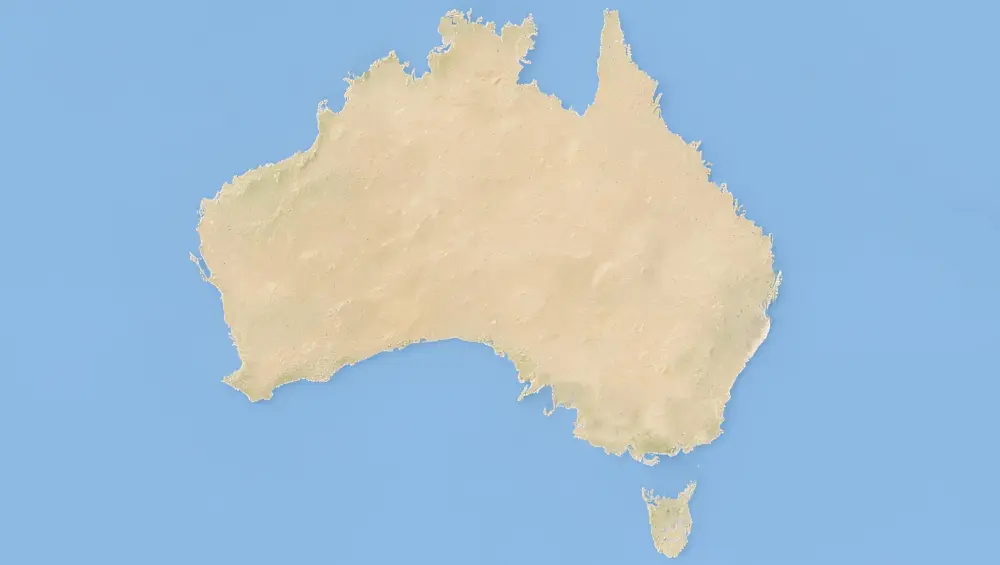
Australia is taking a particularly interesting approach.
In September 2026, Prime Minister Anthony Albanese announced proposed Digital Duty of Care legislation. It specifically identifies content promoting hostile attitudes towards women and gender equality as harmful content from which under-18s should be protected. The proposals include:
- Requiring platforms to assess and reduce risks created by their services.
- Giving users greater control over algorithmically recommended content.
- Protecting children from misogynistic material.Giving the eSafety Commissioner stronger enforcement powers.
- Potential penalties of up to A$109.2 million for non-compliance.
Australia has also funded projects specifically designed to help boys and young men challenge narratives equating masculinity with dominating women.
Australia is particularly explicit about the role of algorithms and technology companies in spreading misogyny. Its approach is not simply about teaching boys to behave better; it is also about changing the environment in which they consume content.
Sources: Prime Minister of Australia; The Conversation.
European Union – treating online misogyny as a cross-border problem

The EU has been developing a coordinated response rather than relying exclusively on individual countries. In June 2026, the Council of the EU called for stronger action to protect girls and young women from cyber violence. It specifically identified:
- Cyberstalking.
- Online harassment.
- Non-consensual sharing of intimate images.
- Sexist hate speech.
- Misogynistic and incel communities.
The EU also called for schools to teach digital literacy, consent, gender equality and recognition of harmful gender stereotypes. Two particularly important pieces of European legislation are:
- Digital Services Act (DSA): places obligations on large online platforms to assess and mitigate systemic risks.Directive on combating violence against women and domestic violence: establishes a common European framework that includes certain forms of cyber violence.
The Council of Europe’s March 2026 recommendation on accountability for technology-facilitated violence against women and girls is one important development. The EU is increasingly recognising online misogyny isn’t confined by national borders. Misogynistic influencers can reach millions of young people across Europe without being physically present in any of their countries.
Sources: Council of the EU; EU Perspectives.
United States – has considerable concern but a more fragmented response
One major issue with the US is its present incumbent who has little interest in the well-being of the country’s women. Instead he chooses to vilify and abuse them, largely in a verbal way. When female reporters attempt to ask questions on policy, he tells them straight to their faces that they are dummies, idiots or stupid. 9 There’s no doubt this acerbic attitude massively fans the manosphere ideal.
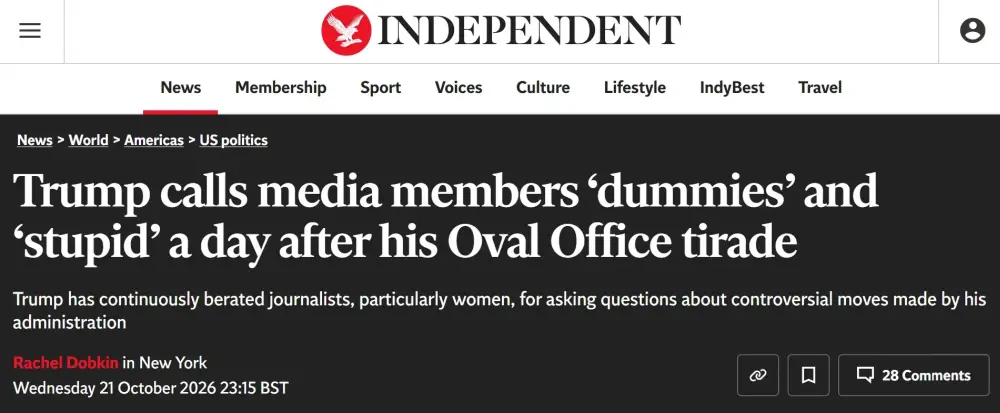
The US is a more complicated picture because it has particularly influential manosphere ecosystem including its President.
In general, the US has not ignored the problem. but there is a considerable gap in terms of public and academic discussion and the degree of coordinated federal action. The following groups have substantial concerns:
- Women’s rights organisations.
- Universities and researchers.
- Child protection organisations.
- Organisations investigating online extremism.
- Campaigners addressing violence against women.
American researchers have also studied the growth of incel communities, male supremacist networks and the relationship between online radicalisation and violence. However, the US has not developed the same comprehensive federal online safety framework as the UK. The OECD’s 2025 comparison of G7 countries found that the UK had its Online Safety Act in force, whereas several US proposals concerning platform accountability remained at the draft stage. This difference is important. The US has a particularly influential manosphere ecosystem, with personalities whose audiences extend far beyond America. Yet its federal response is more fragmented, partly because of constitutional protections around freedom of expression and disagreements over how much responsibility technology companies should carry.
Sources: OECD.
Canada – increasingly concerned about online misogyny and youth protection

Canada has been developing stronger online safety legislation. In June 2026, the Canadian government introduced its proposed Safe Social Media Act, Bill C-34. The proposals would:
- Require social media and AI chatbot services to assess risks.
- Introduce stronger protections for children.Require services to provide safety tools.
- Establish a Digital Safety Commission.
- Increase transparency and accountability.
Canada is also examining the relationship between misogynistic online content, political polarisation and gender inequality. One iparticular research project is comparing the UK’s Online Safety Act with Canada’s proposed legislation, looking at how platform algorithms amplify gender-based divisions. The country is moving towards a more preventative approach despite its legislation having not yet reached the level of emphasis as the UK’s Online Safety Act.
Sources: Parliament of Canada; House of Commons, Canada.
France and Germany – strong European regulation, but less explicit focus on the manosphere

Both France and Germany operate within the EU’s Digital Services Act framework.
France and Germany have legal mechanisms for addressing illegal online content, including threats, harassment and image-based sexual abuse. Germany also has a significant research and monitoring landscape examining online male supremacist activity. A January 2026 study by the Institute for Strategic Dialogue examined online male supremacist communities in Germany, Poland, the Czech Republic and Slovakia and shows that manosphere activity is not simply an English-speaking or British-American phenomenon.
Sources: Institute for Strategic Dialogue (1); Institute for Strategic Dialogue (2); Institute for Strategic Dialogue (3).
A brief summary of who is doing what
Country/Main focus/Approach:
- UK – Misogyny and violence against women. Dedicated national taskforce, education, prevention and regulation.
- Australia- Online misogyny and algorithms. Digital duty of care and child protection
- EU – Cyber violence against women and girls. Coordinated legislation and education.
- US – Online extremism and gender-based abuse. Research, advocacy and fragmented regulation.
- Canada – Online harms and child protection. Proposed platform accountability legislation.
- France – Online abuse and gender equality. EU regulation and national initiatives.
- Germany – Online extremism and male supremacy. Regulation, research and monitoring.
What about countries outside the Western world?
Misogyny is a global issue but takes different forms depending on the political, cultural and economic circumstances of each country.
- South Korea: Has experienced significant public debate about anti-feminism, digital sex crimes, online misogyny and gender conflict, particularly among younger generations.
- India: Has serious concerns around sexual violence, online harassment, misogynistic social attitudes and women’s safety.Japan: Has ongoing debates about gender inequality, sexual harassment and women’s representation in public and professional life.
- Nordic countries: Have established gender equality policies and institutions, but are also confronting online harassment, digital abuse and anti-feminist movements.
There’s no suggestion these countries are less concerned simply because their governments use different language or have different policy priorities. Nevertheless their efforts do indicate things are happening internationally. For many years, misogyny was predominantly discussed as a women’s rights issue. Increasingly, it is being discussed as:
- A public health issue.
- A child protection issue.
- An online safety issue.
- A democratic participation issue.
- A violence prevention issue.
- An issue concerning the commercial power of technology companies.
That is a significant change in the way governments are thinking about the problem – but are they addressing the underlying misogyny, or simply trying to manage the more visible consequences? Its possible to remove abusive posts, prosecute perpetrators and introduce school programmes without directly challenging any wider cultural attitudes that make misogyny acceptable in the first place, which includes the following:
- Attitudes towards feminism and women’s equality.
- Beliefs about male dominance and traditional gender roles.
- Acceptance of controlling behaviour in relationships.Attitudes towards sexual consent.
- Hostility towards women who challenge traditional expectations.
Are other governments tackling the causes or just the symptoms? This is where comparing the UK and Australia could be revelatory. For example:
- Are platforms being held accountable for algorithmic amplification?
- Are schools addressing misogyny before it becomes entrenched?
- Are governments investing in positive models of masculinity?
- Are boys being given healthier ways of understanding identity, relationships and masculinity?
- Are interventions being independently evaluated?
Are women actually seeing improvements? Ultimately, legislation and government initiatives are only part of the picture. They should be looking at measurable outcomes including:
- Sexual harassment and violence.
- Online abuse and threats.
- Women’s experiences in workplaces.
- Girls’ experiences in schools.
- Women’s participation in public life.
- Changes in young people’s attitudes.
In retrospect it does not seem there are any considerable improvements in the way of mitigating certain attitudes towards women. These probably are due to factors the Lancet report does not detail in great depth. Domestic violence for example doesn’t show any sign of abating and the roots of that issue are far more deeper than those of the manosphere because those are tied to culture, tradition, family expectations and even religion.
The problem ahead
There’s more legislation, public discussion, research and greater recognition of the manosphere. Yet that doesn’t automatically translate into safer homes, healthier relationships or greater respect for women. One needs to look beyond government announcements and examine long-term trends in violence, coercive control, sexual abuse and repeat offending including:
- The normalisation of misogynistic attitudes in some social environments.
- The influence of pornography and online sexual culture.
- The commercial incentives behind extremist male influencers.
- The reluctance of some institutions to confront sexism directly.
- The gap between what boys and young men are taught about equality and what they encounter online.
None of these issues should be avoided because they are uncomfortable. The most important test is Are women and girls actually safer, freer and treated with greater equality than they were ten years ago? This is how one ought to measure progress rather than simply counting policies and initiatives.
References:
- Sky News: Meta, TikTok and X lose hearing against UK watchdog over moderation data demands [Accessed October 2026] ↩︎
- UpGuard: Biggest Data Breaches in the UK [Accessed October 2026] ↩︎
- Wikipedia: List of UK government data losses [Accessed October 2026] ↩︎
- SBS News: The new scam that could target anyone scrolling social media [Accessed November 2026] ↩︎
- 9 News: There’s a warning tonight about a rise in fake digital IDs being sold [Accessed November 2026] ↩︎
- myID: How to verify or report a scam [Accessed November 2026] ↩︎
- BBC News: Twitter row victim Caroline Criado-Perez: ‘I feel under siege’ [Accessed October 2026] ↩︎
- BBC News: MP Stella Creasey in Twitter message crackdown call [Accessed October 2026] ↩︎
- Independent: Trump calls media members ‘dummies’ and ‘stupid’ a day after his Oval Office tirade [Accessed October 2026] ↩︎