Is humanity attaining a greater idiocy?
In our modern world, intelligent individuals regularly make baffling decisions. These could be any number of professionals whose contradictions raise concerns. Why such poor decisions? Immanuel Kant identified this trait centuries ago, calling it ‘immaturity’ – the refusal to use one’s own understandings without guidance from another. Kant says society educates and meshes people together in such a way the result is idiocy. Its a pattern that has killed off previous epochs and in today’s society what we’re seeing is a collective idiocy.
It may not be that humans won’t see the problems — but its more that we often can’t see the problems. Human brains evolved for survival not comprehension. Climate systems, economic feedback loops, AI risk, biodiversity collapse — these are nothing of the sort like a predator in the bushes. Basically there’s no leopard that will jump out and maul us. Yet there is a world that jumps out and threatens to destroy us but we have little means of becoming fully cognizant on this. Our brains have difficulty grasping a world that’s not built for survival but is more about wisdom and logic.
In the mind of Kant, self‑incurred immaturity is not actually caused by stupidity but a lack of courage and determination to use one’s own understanding without relying on others. He says its a lack of resolve and courage to use it without guidance and he further blames ordinary “laziness and cowardice” for why people stay in this dependent state. There’s no doubt irrationality can develop and this becomes an avoidable refusal to use what can be deemed true reasoning.

Immanuel Kant transports to the present time to ascertain the progress society has entailed. He wonders, are humans more clever or more immature?
In a modern society such as that we live in, stupidity certainly becomes a factor. Its not that people become stupid deliberately but chose to filter information in what can only be an abject logic. Its merely accepting common reasoning and basically questioning no further thus discounting an independent and quality based knowledge. It takes great effort to negate even what one has been conditioned to understand.
We could ask ourselves a question. Is it hard? Yes. Is it impossible? No. But what is difficult is achieving much anew without redesigning the inputs that currently reward the opposite behaviour. There are of course examples of brilliant minds that have proved such a change is possible. Einstein conceived theories that went beyond the popular acceptance of what was known. There’s no doubt Einstein employed insight and reasoning beyond anything attempted before, and its why his theories of relativity are still extremely radical, even to this day.
Apart from relativity, Einstein too attempted to go beyond the accepted norm in terms of moral outlook. His famous quote on the universe and stupidity1 was intended to show humans were indeed learning about the universe, but at the same time were doubly stupid because they could only think of things such as war and violence. Its why Einstein thought World War IV would be fought with sticks and stones.2
Many aspects of Kantian thought impressed Einstein and that is because he had studied Kant! By the age of 16, Einstein had perused Kant’s three major works. These helped Einstein formulate his thinking including the notion of space and time. When it came to relativity, Einstein adopted Kant’s Sapere aude. The notion of space and time were rejected – and spacetime was born.
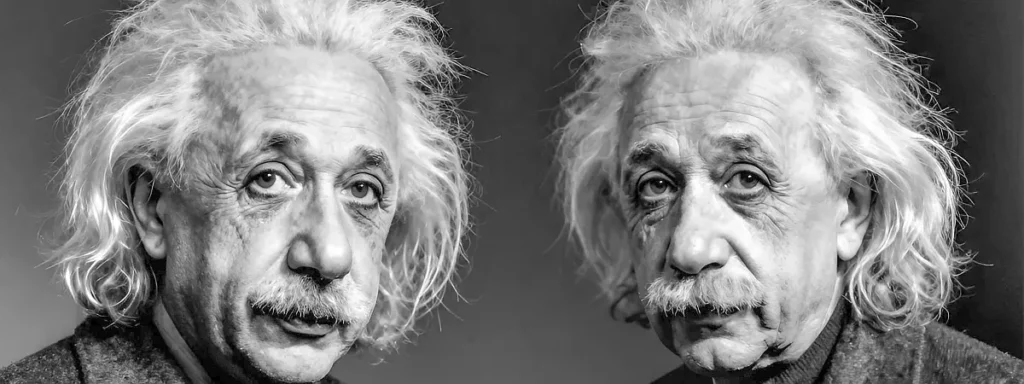
The conformist Einstein versus the non-conformist Einstein. Leaps of faith occur in the mind, yet more rarely so in one’s physical appearance.
There’s no doubt a mismatch between what our minds are good at and what the deeper sense of the world demands understanding. Its what one could call immaturity, and this brings us to Kant once again. In his view immaturity isn’t merely a lack of intelligence; it’s a state of being that’s rooted in fear of questioning widely accepted norms or the familiar. It results in poor decision-making and potential large scale societal collapse. Its an ancient pattern that’s being repeated ad infinitum.
This way of thinking breeds habits and conformism becomes the norm. ‘Proof’ that fits peoples’ views offers inherently conclusive opinions and views, thus there’s no need to consider any other indication these might be wrong. Feelings are more important than mere logic. Anything that could make a real difference is shut out.
Today access to information is hugely vast, yet immaturity and lack of wisdom continues. Algorithms manipulate perceptions, easily reinforcing existing beliefs whilst stifling critical thought. This pools vast areas where problems begin to arise. Rather than pursuing a greater understanding, specialists flourish as experts in increasingly narrowing fields. Society is soon in the makings of a decline. The emotional assurance that comes before factual truth continues to perpetuate poor decision-making and the decline worsens.
There’s one caveat in all of this! Kant himself could have been a rare phenomenon in a societal oasis where mental decline was the norm anyhow. When one compares the intellect of Kant’s time with that of the Greek philosophers for example, could one have discerned a difference in intellect? There’s many others with brilliant minds no doubt, even so it could just as easily be due to advent of the printed word, thus its a difficult science in determining intellect.
Scientist Gerald Crabtree3 has argued people in the distant past certainly had more intellect. That depends on how things are measured. If humanity has indeed been declining over a long period of time, its possible what we see now is merely part of that lengthy process. In the 21st century it could be accelerating due to IT, AI, social media, the desire to flick through news, stories, facts and other stuff without really reading anything properly.
The human mind these days certainly has a far shorter attention span and there’s fresh evidence the younger generation exhibit less intellect. ‘Gen Z is the first generation to underperform their parents in attention, memory, and literacy skills.’4 Its no doubt a major shift in human cognition.
Sapere aude – the call for action
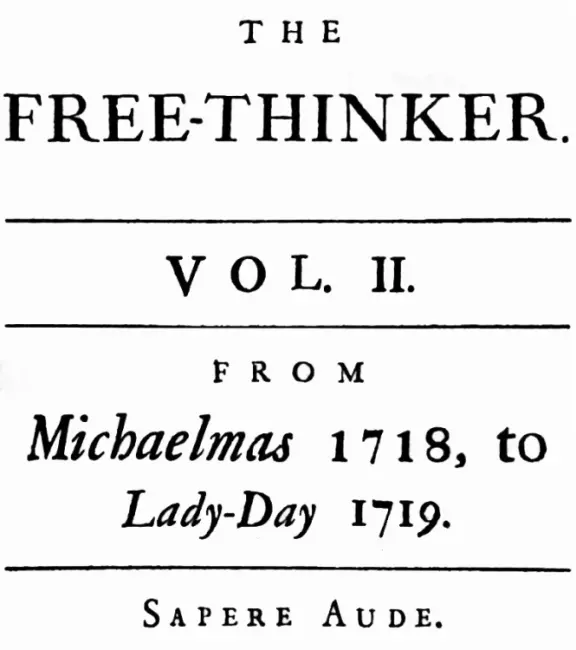
The Free Thinker frontispiece with its Sapere Aude motto.5
Kant’s ‘Sapere aude’6 (Dare to know), urges the proper use of understanding. We must actually learn from history. We can’t fix everything but can resist being part of the problem.
Dare to be wise: begin!
He who prolongs the hour of living rightly,
waits for the rustic until the river flows down;
but he slips and slips into every rolling age.
It is the courage of the individual man to abide the advice of Sapere aude7 that will break the chains of despotism, and reveal better methods of governance and legitimate concern. Sapere aude is “a reminder that wisdom is having the courage to sit with the questions long enough to form your own conclusions. The courage to reject the defaults. Remember: The answers you seek are found in the questions you avoid.”8
The term Sapere aude originated with Horace,9 a Roman poet who lived toward the end of the BCE period. Essentially the term denotes a leap of faith, or more accurately, “Have the courage to make use of your own understanding.”10
Immanuel Kant’s 1784 essay defines enlightenment as humans freeing themselves from ‘self-incurred immaturity,’ meaning the inability to use their own understanding without guidance from others. This immaturity comes from laziness and cowardice, not a lack of ability, and Kant’s motto is “Dare to know!” encouraging independent thinking.11
Kant’s famous call to “dare to know” became the motto of the Enlightenment and the rallying cry for anyone tired of being told what to think. This Latin phrase means having the courage to use your own understanding instead of letting others do your thinking for you. Perfect for those ready to question everything.12
No matter how much one likes something, often it is they will have to renege their feelings and emotion and get rid of whatever it is they can’t bear to let go of. Its why a lot of philosophers, mystics and religious people live a simple life with little in the way of worldly goods. Its a means of focusing on wisdom rather than the need to acquire things. And yes, there’s no doubt many people acquire a poor knowledge of things.
- https://quoteinvestigator.com/2010/05/04/universe-einstein/ ↩︎
- https://www.snopes.com/fact-check/einstein-world-war-iv-sticks-stones/ ↩︎
- https://en.wikipedia.org/wiki/Our_Fragile_Intellect ↩︎
- https://www.facebook.com/ScienceNaturePage/posts/global-data-reveals-gen-z-is-the-first-generation-to-underperform-their-parents-/1451711349743063/?locale=en_GB ↩︎
- https://books.google.co.uk/books?id=VAM-AQAAMAAJ& ↩︎
- https://en.wikipedia.org/wiki/Sapere_aude ↩︎
- https://en.wikipedia.org/wiki/Sapere_aude ↩︎
- https://www.threads.com/@sahilbloom/post/DHioYuKo1j2/sapere-aude-is-a-latin-phrase-meaning-dare-to-know-its-a-reminder-that-wisdom-is ↩︎
- https://en.wikipedia.org/wiki/Horace ↩︎
- https://persistentenlightenment.com/2013/01/23/sapere-aude-incipe/ ↩︎
- https://moments-of-now.com/sapere-aude-dare-to-know/ ↩︎
- https://the-philosophers-shirt.com/en-gb/collections/sapere-aude ↩︎