To be or knot to be? A prevalent history
“All happy families are alike; each unhappy family is unhappy in its own way.” The preceding quote was penned by Leo Tolstoy and gained prominence in Anna Karenina (1877). In some quarters this is related to what’s known as the Anna Karenina principle. 1 That denotes a means of determining whether a marriage is even going to be happy, it must succeed in several ways. For example a failure to elevate or procure key elements means, for success to occur in a complex endeavour, anything even a marriage, that does not meet the criteria means its inevitably doomed.
In history however, it can be considered that long lasting marriages were not exactly a sign of happiness. They denoted helplessness because the male had so much control over the women. Marriage was a way to ensure women were not only being submissive, but were able to survive. Marriage did offer a level of protection. The fact many women can now choose to work and have careers no longer means that marriage holds any sort of value, not even to the men. It is a kind of clouded romanticism which ensures marriage continues.
"All happy families resemble one another; every unhappy family is unhappy in its own way."
— Alex Bilzerian (@alexbilz) March 10, 2023
—Leo Tolstoy (the opening line of Anna Karenina, 1878) pic.twitter.com/v9od3VFQu1
Here are some other Anna Karenina quotes on relationships and marriage:
“I’ve always loved you, and when you love someone, you love the whole person, just as he or she is, and not as you would like them to be.”
“The only happy marriages I know are marriages of prudence.”
“Whether we shall be the happiest or the wretchedest of people—that’s in your hands.”
“He was happy; but on entering upon family life he saw at every step that it was utterly different from what he had imagined.”
“‘Everything is at an end, and that’s all,’ said Dolly. And the worst of it is, you understand, that I can’t leave him: there are the children, and I am bound. Yet I can’t live with him; it is torture for me to see him.”
There’s no doubt tying the knot is enormously problematic. One wonders why humanity even wants such a means of co-habiting. The problem is togetherness – or marriage as it is regularly called – is steeped in tradition but also in how its historically been a tool for men to control and dominate the female.
On paper, Tudor men had complete power over their wives. Upon marriage, a woman’s dower lands became the property of her husband for him to administer as he saw fit. If she outlived him she would regain those lands (or the equivalent if her husband had traded, sold or lost them) and hope that he had looked after them in the meantime. 2
Let it be known Tolstoy couldn’t have put it better when he had conceived of the various plights his Anna Karenina characters would have to face. Take his own family for example. His wife, Sofia wrote:
August 15. There are crowds of people here; they are all so good-natured and not at all spiteful or secretive, as in our family hell. I think my husband’s treacherous behaviour has weakened my love for him. I can see it in his face, his eyes and his whole mien, that spite which he vents on me all the time; and that spite is so unattractive and uncalled-for in an old man, especially when to the rest of the world he keeps preaching about “love”. He knows he is tormenting me with those diaries, he is doing so on purpose; I pray to God to help me disentangle myself from this insane attachment to him. How much freer and easier my life would be if I could!
August 28. Lev Nik said today that the Christian ideal was celibacy and total chastity. I retorted that the two sexes were created by God, that was His will, so why did one have to go against Him and the laws of nature? LN said that besides being an animal man also had reason, and this reason must be inspired and must not be preoccupied about the perpetuation of the human race; for that is what distinguished us from the animals. All well and good, if LN was a monk and an ascetic and lived a celibate life. But meanwhile at my husband’s wishes I have conceived 16 times by him, 13 living babies and 3 stillborn.
Everyone seemingly marries the wrong person. There’s no such thing as Mrs or Mr right. Its said marriages are made in heaven but that’s a way for the religious authorities to, erm, drum up business! The more faithful followers the better! As Sofia Tolstoy showed, forty eight years of being married to the same man proved it was very difficult to be ever faithful. There’s no doubt the idea of matrimonial union has to be something made in hell!
No wonder divorces rise inexorably.
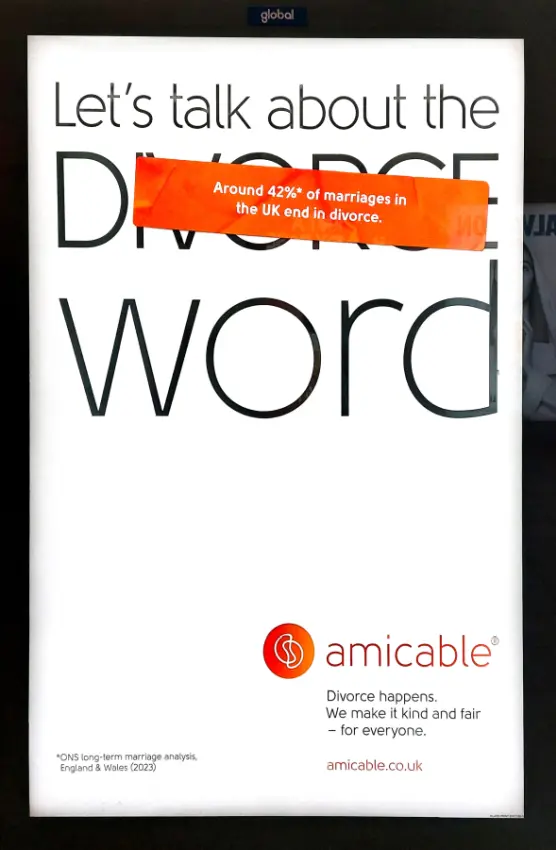
Around 42% of marriages in the UK end in divorce. One of a number of ‘divorce’ adverts seen on London’s tube.
In the early years of the 20th century, just one divorce arose out of every 450 marriages. Before 1914 divorce was rare; it was considered a scandal, confined by expense to the rich, and by legal restrictions requiring proof of adultery or violence to the truly desperate. 3 In 2023, there were 102,678 divorces in England and Wales, and that was after a low in 2022 due to COVID. Today, the going rate is for every two or three marriages, at least one will end in divorce.
The question of getting hitched has been known for centuries. Let’s take a fairly recent example of how that dilemma would have been perceived. While its not exactly representative of the problems that are faced, what it does is to highlight the sort of straitjacketed approach to securing a relationship. Gurney Slade – a ventriloquist’s dummy who became sentient for a mere six episodes of television gets to ask a married man whether he had ever been conscious that the choices he had made could have been wrong. In a sense it was a focus upon the world humanity lives in and the apparent realities that world offered. Essentially what it amounted to was whether getting hitched, relationships and falling in love happened to be a mere construct.
Slade’s idea is that no-one can ever find the right person. What on earth is this right person even? What it boils down to is an assumption, an illusion of sorts that the right person has been found. Even when the ‘right’ person is met its a bit of a fumble because, well, social etiquette and rules and morals dictate that can’t just go and chose their future partner. Besides, how can one even determine the right choice? Reality soon makes the rounds and that’s when the whole notion of marriage hits the rocks
Gurney subtly suggests the world has failed because so many marriages have been to the wrong person. Those wrong choices have led to a poorer history of the world. “You see, so many people are born in a trap, and they don’t seem to have the courage to want to get out. And it’s so simple”. That’s a sobering thought!
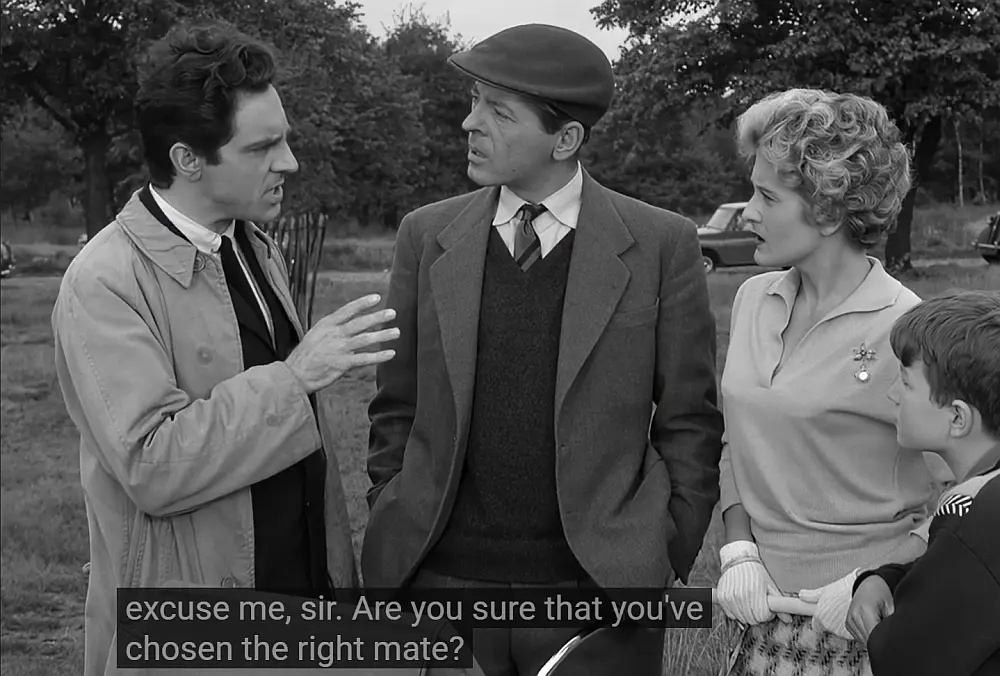
Screencap from the 1960 TV series The Strange World of Gurney Slade – Youtube.
Gurney Slade mulls upon the problem and he says:
The whole course of history would have been changed if men and women were allowed to fall in love with their chosen partner. Supposing Josephine had followed her true desires, she she wouldn’t have gone within a mile of Napoleon, and it would have done him a bit of good, too. He wouldn’t have been so worn out for a start. Then he wouldn’t have retreated from Moscow. The Tsarists would have had it all their own way, and Khrushchev wouldn’t have been the man he is today.
Josephine de Beauharnais and Napoleon Bonaparte are perhaps a good example of the idiocy of marriage. Napoleon wanted a heir. Inevitably Josephine couldn’t deliver. Napoleon felt it amounted to a failure. This, among other things, including infidelity, made their marriage such a rocky venture. In the end divorce was the only answer. Napoleon was such a big guy (in terms of history) and he was absolutely convinced a divorce would be in the best interests of France.
In respects it can be said marriage provides a messy historical footprint. Would France have been better off if Josephine and Napoleon had not married and a heir had been procured by way of a different matrimonial union? Clearly this amounts to the notion that “life is lived forward but understood backwards”. (Kierkegaard).
Marriage is no doubt something that can only be looked back upon as a mistake once the couple have been through all the motions. Mistakes cannot surreptitiously be avoided in advance no matter how much one tries. Let’s look at some more of the backwardness in terms of that so called matrimonial unity…

Marble bust of Nero. Wikipedia.
Nero was a Roman emperor from AD 54 to 68. He was noted for debauchery, extravagance and tyranny. After getting rid of Octavia, his first wife, Nero took two more, Poppaea Sabina and later Statilia Messalina. Octavia had soon bored Nero and he treated her badly. Nero said “Being an emperor’s wife ought surely to be enough to make her happy!” Nero tried to strangle Octavia a number of times but finally divorced her. As if that wasn’t enough, Nero soon after had her executed on a charge of adultery.
Though Nero doted Poppaea, whom he married 12 days after giving Octavia the push, Nero kicked Poppaea to death while she was pregnant. That was because Poppaea had dared to complain the Nero was coming home late. As for Statilia Messalina, Nero murdered her husband in order to remove any resistance to a potential union.
Two millennia or so later after the era Nero lived in, we find that Emily Lyon, who had married Sir William Hamilton in 1791, had became embroiled with Admiral Horatio Nelson. Sir Hamilton said of the affair:
I have no connections out of my own family. I have no complaint to make, but I feel that the whole attention of my wife is given to Lord Nelson and his interest at Merton. I well know the purity of Lord Nelson’s friend-ship for Emma and me, and I know how very uncomfortable it would make his Lordship, our best friend, if a separation should take place, and am therefore determined to do all in my power to prevent such an extremity, which would be essentially detrimental to all parties, but would be more sensibly felt by our dear friend than by us. Provided that our expenses in housekeeping do not increase beyond measure (of which I must own I see some danger) I am willing to go on upon our present footing; but as I cannot expect to live many years, every moment to me is precious, and I hope I may be allowed sometimes to be my own master, and pass my time according to my own inclination.
In Ireland just a few short years later George Frederick Nugent, the 7th Earl of Westmeath sought damages against Augustus Bradshaw for adultery with Mary Anne, Countess of Westmeath. The claim, made during 1796, saw damages of £10,000 awarded. 4 George and Mary Anne were divorced soon after.
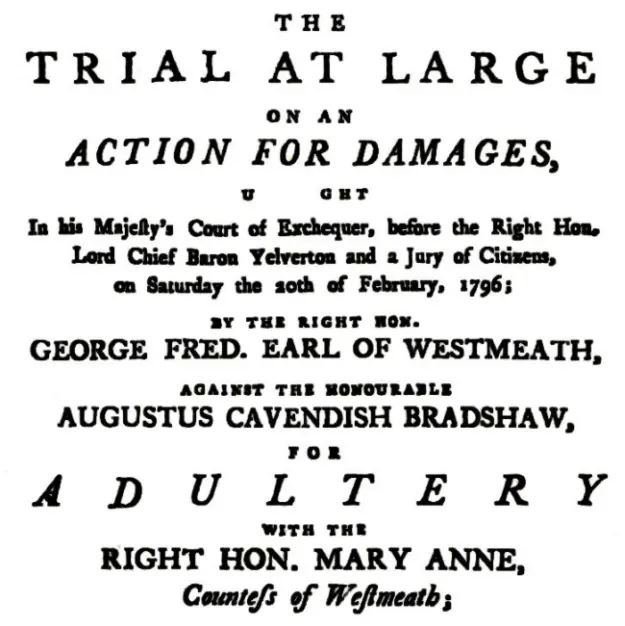
Bradshaw and Mary Anne married that same year. Bradshaw was a MP between 1805 and 1817 and known as a ‘pretty, little, thin, delicate man’.
The name of Westmeath saw further turmoil in terms of wedded bliss. This involved the 7th Earl of Westmeath’s son, George Thomas John Nugent. He married Emily Anne Benet Elizabeth, who became the Marchioness of Westmeath. 5 The marriage took place in Hatfield House, Hertfordshire. Things soon turned sour and there was much ado in terms of infidelity. There was also physical and verbal abuse – which included attempted suffocation by pillow while she was pregnant. Emily sought a conjugal separation in the ecclesiastical courts in Dublin during 1825. 6 The case is notorious for the huge difficulties which made divorce an almost impossible endeavour in those days.
Almost as soon as the Hatfield House ceremony was over, the Westmeaths moved from England to Ireland and resided at Blackrock. From that point onward Lord Westmeath conducted what could only be an incessant campaign of brutality. One such instance of the violence that ensued between the couple took place at Paris in 1815. “Lord Westmeath struck Lady Westmeath a violent blow, saying, at the time, ‘Go to hell, I wish I had never see you.'” (Morning Post 18th December 1826).
The Marchioness’ lady in waiting, Janet, testified that Lord Westmeath had often been responsible for the conduct that ensued whilst Lady Westmeath, in the face of such adversity continued to remain calm, even though at times she was seen crying. Lord Westmeath regularly spoke to her in a violent tone. On one occasion Lord Westmeath told the Lady in no uncertain terms he was the master and she would obey him. By 1817 the frequency with which these disputes certainly had increased and this is what prompted the Lady Westmeath to write to her husband.
Here are some extracts from that letter, written in September 1817:
You first took me away from all my friends, as good as shut me up in an obscure corner of the world, without horses or servants to stir out. In the bitter winter of ’13 and ’14 I was in a room not papered, sashes rotten, with child, and very ill; not allowed anything but green wood because turf was two shillings a kish instead of one. When my child was 12 hours in the world you told me you would be damned if you gave 25 guineas a year to a bitch of a nurse: ‘Why the Devil could not I nurse her myself?”, tho’ the Dr told you I was unable. Three weeks after, the child was to be disinherited and settle everything upon Thomas [the Earl’s half-brother].
You beat me. You endeavoured to place (I will call things by their proper names) a pimp’s daughter as my own maid, her nephew a postmaster; and all this time, when I was undergoing all the privations I mentioned for want of money, you could find money for a prostitute. You could believe her word when she saddled herself and her children upon you and did you the honour to tell you they were yours. You dared tell me that you had injured her. You lived three years with me in constant deceit.
I will never live with a man as his wife, who thought any other woman and her children had the slightest claim upon him. You and I are not intended for each other, and cannot understand each other.

The Westmeaths – headlines in the Morning Post, London, for 18th December 1826.
The legal hearings that took place in court were often the subject of intensive scrutiny. Indeed entirely full page coverage in a number of broadsheets had demonstrated there was such enormous interest in the Westmeaths as they battled it out in the courts. Very detailed accounts of the stormy union were regaled in the newspapers, including the numerous swear words Lord Westmeath had used. The Marchioness’ turbulent marriage and subsequent divorce led to a campaign for legal reform. This raised issues involving women’s rights and the legal complexities that revolved around marriage.
That very last line by Emily Marchioness of Westmeath (I will never live with a man as his wife, etc), is certainly food for thought. Men are from Mars and women from Venus. Any union between the two is a mere fantasy for both rotate in totally different orbits with the potentiality to cause no less than a sheer cataclysm. Those who do get through with flying colours, there’s no doubt they are among the few to have found a magic formula (if such a thing exists) that keeps oblivion at bay. That is, ’till death us do part’.
- https://en.wikipedia.org/wiki/Anna_Karenina_principle ↩︎
- https://thehistoricalnovel.com/2013/05/10/fiction-feminism-and-marriage/ ↩︎
- https://www.parliament.uk/business/publications/research/olympic-britain/housing-and-home-life/split-pairs/ ↩︎
- https://www.historyofparliamentonline.org/volume/1790-1820/member/cavendish-bradshaw-hon-augustus-1768-1832 ↩︎
- https://grokipedia.com/page/emily_nugent_marchioness_of_westmeath ↩︎
- https://www.dib.ie/biography/nugent-george-frederick-a6249#:~:text=After%20many%20vicissitudes%20%E2%80%93%20the%20earl,’%20(Stone%2C%20581). ↩︎