Bonhoeffer’s three elements of stupidity
Big Think’s Youtube video – out less than a day ago – entails an interview with Jonny Thomson. The talk revolves around Bonhoeffer’s theory of stupidity and this video is certainly great in how Thomson explains Bonhoeffer’s theory. There are good and clear examples of what entails stupidity, foolishness, conformity and other things. Thomson explains how evil happens to be the most extreme form of stupidity – again that devolves much of what Bonhoeffer’s theories had deducted during World War II when the Nazis constituted a massive threat to humanity.
Here’s the link to Big Think’s video – The 3 elements of stupidity, according to philosophy.
Thomson describes Bonhoeffer’s theory with a number of examples that set stupidity apart from foolishness and ignorance:
- Foolishness involves reckless or imprudent actions (e.g. putting diesel in a petrol car).
- Stupidity is distinct from lacking ability (e.g. struggling with flat-pack furniture).
- Ignorance is a lack of knowledge which can be remedied, whereas stupidity persists despite awareness.
These can be applied into the following scenarios:
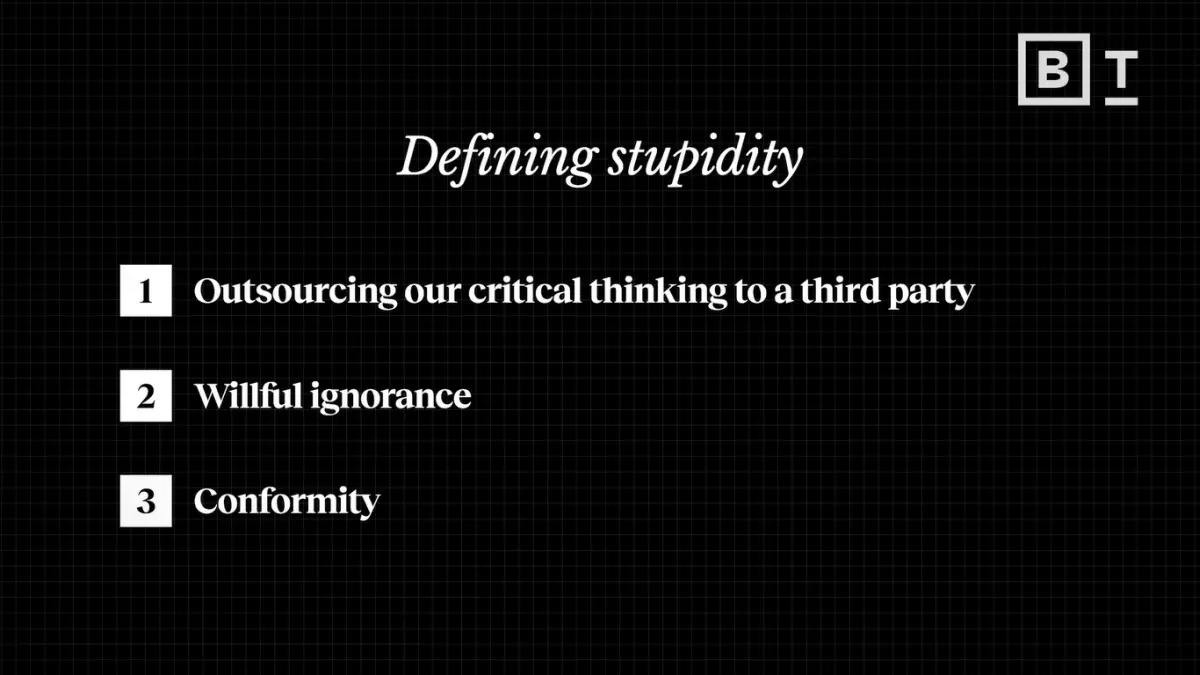
| Element | Description | Example/Detail |
|---|---|---|
| Outsourcing Thinking | Relying on others (teachers, influencers, technology) to do critical thinking for oneself. | Using AI (ChatGPT) for moral decisions instead of personal reasoning. |
| Willful Ignorance | Persistently refusing to resolve ignorance. | Ancient Greek Amathia: celebrating not knowing and rejecting learning. |
| Conformity | Abandoning independent thought to follow group identity or party line. | Nazi regime intellectuals who conformed to ideology despite education. |
One aspect of Thomson’s talk that I liked very much was how democracy and politics are essentially elements of stupidity. For example, as in the case of the UK, the Chief Whip (which every main political party in Parliament has) is given the responsibility of ensuring the party’s MPs toe the party’s ascribed policies. That they do things exactly in the way the party wants. In other words their thinking is outsourced to a chief influencer – and this, very importantly, is one of the elements of Bonhoeffer’s theory. This being that thinking is not one’s own but that of another person. Its what’s known as conformity.
Intelligence according to Bonhoeffer is measured by the ability to think critically. It’s measured by the ability to take evidence, to condense it, and to take on what is good and to reject what is bad. It’s to think for yourself. Don’t outsource your thinking to technology. Don’t outsource your thinking to an influencer, an academic, a teacher, your parents, whatever. And so what do you see in power? What do you see particularly in democracies? What you see is that when people are elected, they no longer are individuals. They’re no longer seen as individuals. They are seen as part of a party system. So what you see in political party democracies such as the United States, such as United Kingdom and all over Europe is you have these party democracies where people are expected to surrender their own critical thinking for the wider party. You have to tow the line.
In the UK, we have something called the the three line whip where you have a whip, which is the title you give to somebody within your political party who will go around all of the politicians and will say to them, “You know which way you’re voting, don’t you today? You’re not going to vote the other way, are you? You know exactly which way you’re going to vote, don’t you? Now, it might be that each of these individual politicians has their own beliefs. It might be that they have their own thought process. They have applied their critical thinking to the issue, but what they have to do is they have to vote according to the party political lines. They have to obey the whip. There are versions of the whip across all sorts of political parties. Bonhoeffer is saying that when you get power, you are expected to tow the line… (Youtube).
Thomson’s talk later brings into play the thought of Descartes. In respects I am not sure this is any sort of positive thing – even though he explains Descartes’s views in a good and meaningful way. There’s no doubt Descartes had much to contribute and he was certainly a very analytical figure. He asked questions of existence and what it meant to think and perceive. However the one issue with Descartes is his theory of dualism. During an interview for a Philosophy BA at University College London some years back, I was asked to explain in detail the pitfalls of Descartes’ dualism – something I was able to do with alarming clarity because I had studied dualism and the question of speciesism. Maybe its why my BA application was rejected!
Basically Descartes’ dualism is something that has caused what can only be a sheer human stupidity. This is humanity versus nature. Such a demarcation has produced a lot of significant problems. In terms of dualism it means animals have no sentience or rights (they were what Descartes called unthinking automata) hence animals could be abused. The same goes for nature which Descartes viewed as a simple machine without any sort of complexity.
Thus nature was inert, passive, and dead and the exploitation of countless environmental resources without any moral hesitation could be enabled and however humanity could wish it to be exploited. After all, the view was basically nature would never hope to fight the power of humanity. Its absolutely clear Descartes placed humans far above everything else in what was a grossly mistaken philosophy. Invariably, as humanity gets to see more and more, this dualism has been responsible for what are becoming an increasingly series of concerning factors that can be attributed to environmental degradation. Global warming, huge firestorms, flooding, degradation of land, air quality etc. In a way I think Descartes put in place what could only be a massive stupidity – and that because humanity is just far too obtuse to even see the problems that have been caused by such ways of thinking. Its a stupidity that is continuing to give problems and make it very costly for humanity to even put right because the effects reach far into a distant future.
In Descartes’ meditations, he says that everybody should at least once in their life question everything that they believe because it’s so easy to walk through life inheriting our beliefs. We say things that our parents said. We will repost stuff that our friends have posted. And so a lot of our beliefs are given to us. They are implanted in our heads. And so what Descartes says is that we should occasionally throw all of those beliefs out because Descartes says that it might be that one, two, three, or many of our beliefs are corrupt. He gives an analogy of an apple basket or an apple barrel. He imagines that there’s a big barrel of apples and we know that within this barrel somewhere is a rotten apple. Now what should we do? Yes, we could take the long diligent time to pull every apple out and to look for the rot. But what Descartes is saying that what you should do is throw all of the apples out and start from scratch. (Youtube).
Thomson’s explanation is a good way of putting it but there’s also a certain irony in this parable of separation from nature!
In other aspects, Thomson makes it very clear in the case of today’s digitally intensive world that social media very clearly facilitates what can only be an outsourcing of thought. It also promotes group think as well as the erosion of rational debate. For example people who repost stuff often do so because they are merely in agreement with what is being said. They’re not giving their own individual thoughts.
As I see it, overcoming stupidity requires personal intellectual humility and respectful interpersonal dialogue, plus a necessity for dissent and critical thinking. However we are failing to produce what can only be credible alternatives to the current ways of thinking and discourse. Its becoming increasingly apparent in the numerous disasters and pitfalls humanity is encountering. Hence many see little means of fully realising what can only be a truer alternative thinking. That is because the future appears to show unmitigable horrors that are beyond the realms of any possible rationality.