Pardoned! But the problem’s still extant
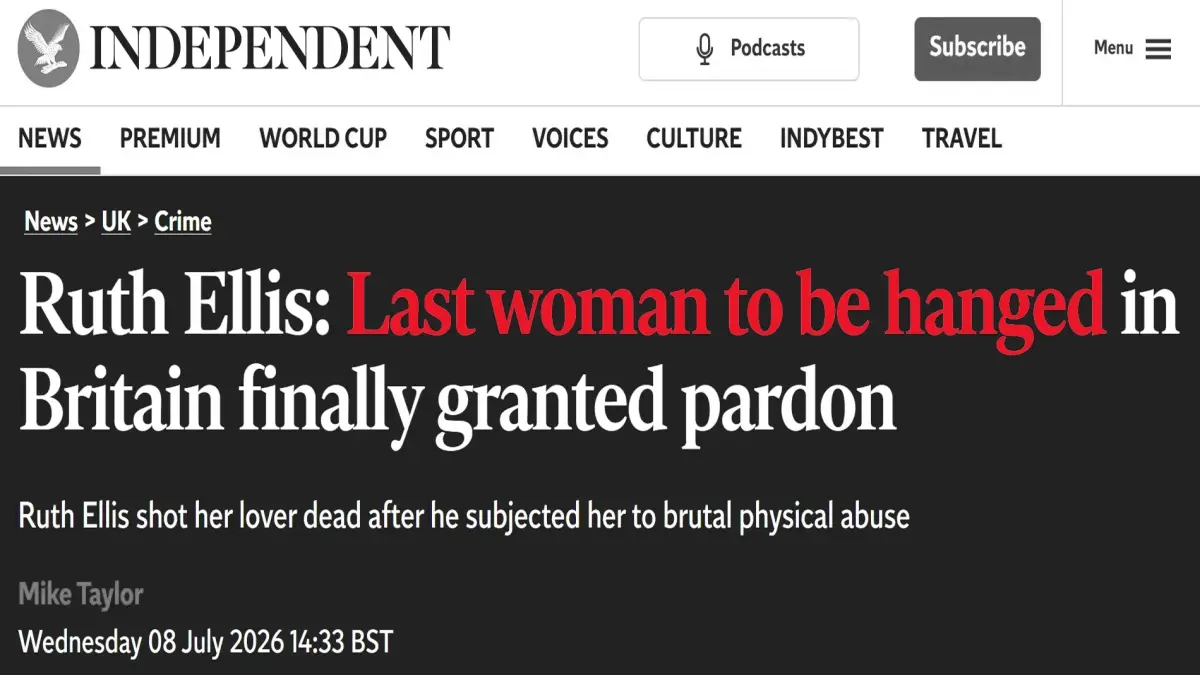
Today’s news that Ruth Ellis, the last woman to be hanged in the UK, has received a posthumous pardon, is of great interest. At first glance it looks like a gross miscarriage of justice has been reversed. However its not as simple as that. Basically the pardon means the sentencing for the murder of her partner has been transmuted to one of life. This was achieved by means of her family campaigning for a review of the hanging and that was focussed on the basis that David Blakely had psychologically and physically abused Ruth.
No doubt the torment led her to shoot Blakely in desperation.
Ellis’ family were determined to right what has been perceived as a gross historical injustice.
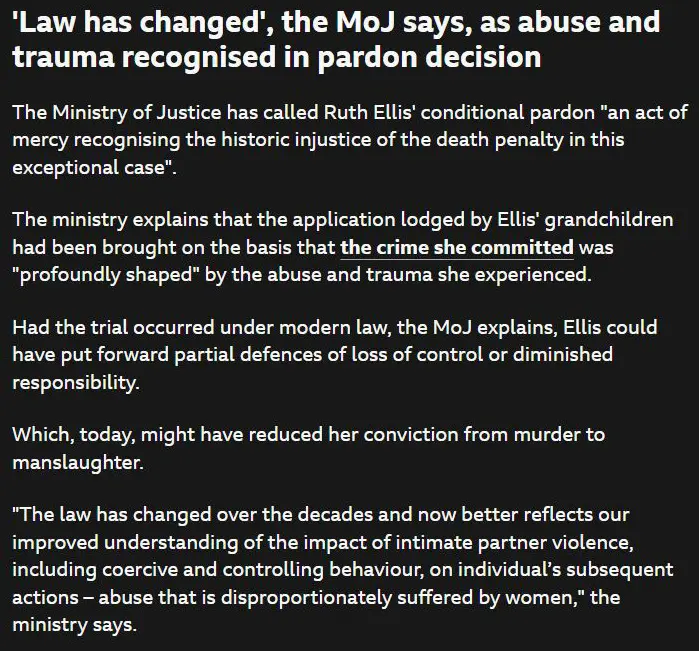
BBC News – Ruth Ellis gets a conditional posthumous pardon – the MOJ explains its reasoning.
But the reasoning behind the Government’s decision is backwards, idiotic even – because it still sees her as a murderer. In a sense I do not agree with that. The whole sense of ‘murdering’ should be viewed with some questioning especially in cases like this – and that because of the contrived ways the justice system has been set up, including up to 1955 and beyond. Then there’s the amount of overview men have of the justice system – including abusers too.
Today I announced that the King has acted on advice and granted a conditional pardon to Ruth Ellis, the last woman to be hanged in the UK.
— David Lammy (@DavidLammy) July 8, 2026
A victim of sustained domestic, physical and sexual abuse, Ruth's case was marked by exceptional circumstances.
We cannot rewrite history,…
Ruth should have had her conviction quashed. One argument in support of that notion which was published today can be seen here. The Government didn’t do that. Some might wonder why this is problematic. It is problematic for a number of reasons – including the fact it undoubtedly instilled fear into other women who suffered badly at the hands of violent husbands or partners. That because in those days few actually believed men conducted domestic violence. And if instances of that were known people tended to look the other way because what went on in a marriage was no-one’s business. The whole schematic around this clearly meant women had to either accept their lot or seek official avenues for redress – should the police forces of the time have believed the victims’ testimony to start with.
In accepting their lot women would often come up with excuses as to why they had got bruises, cuts etc. Few were going to believe it was a violent male who had done these things, and this is because marriage was seen as a sacred ground where everyone lived happily ever after and produced beautiful offspring.
What it means is Ruth Ellis killed David Blakely because there was no other option. In those days (and even to an extent now) the police, the law, has difficulty believing it when a woman says she is being abused. The overlords of the system undoubtedly being men has to be a considerable factor in this miserable affair. Thus in simple words, there is little fall back for female victims to get justice or their partners/husbands removed from the victims’ homes/the victims’ lives. Further back in time there was the case of Celia, who was raped numerous times by her slave owner, Robert Newsom. She killed him and it ended in her being hanged for the crime. The story is old but never changes in terms of how the crime ought to be ascribed and its the woman who gets the full justice system upon her rather than the male abuser.
Unfortunately Ruth Ellis had nowhere to turn to and so she took matters into her own hands and shot David Blakely outside a pub near Hampstead Heath station. As a result of that incidence, what was no doubt a near 100% male dominant system was able to show its sleight hand of patriarchy. The incredulity with which some, including the police, view domestic violence, has been extremely problematic. For example those at the behest of a violent husband or partner would often be very embarrassed to go to the police to tell them they were being beaten up by their husbands.
This is why many campaigned against the death penalty. The full acuity of a crime or some misdemeanour usually transpired after it had been too late and the death penalty administered. There were huge protests against the hanging of Ruth Ellis. Ultimately the state became the judge jury and executioner – it has not in any way understood the circumstances or even accepted there was a thing such as domestic violence. As Mrs Van Der Elst argued in her seminal 1937 book, ‘On the Gallows’, crime and poverty were intertwined and there were considerable imbalances in the criminal justice system. One of the injustices of the day would now be seen as domestic violence, but back then, even in Van Der Elst’s day, it was a concept little understood – and that is why Ruth Ellis got hanged.
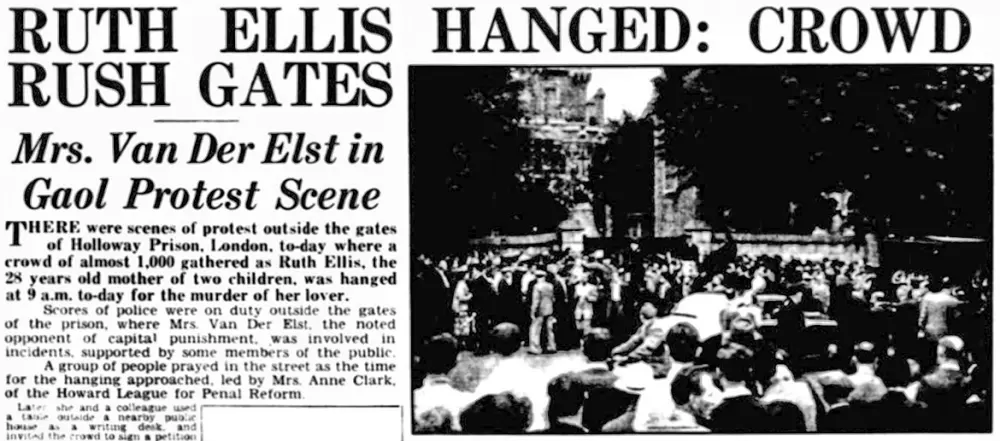
Ruth Ellis hanged and crowds gather outside the gates of Holloway Prison in protest. Coventry Evening Telegraph 13th July 1955.
The sentencing of Ruth Ellis and her subsequent hanging no doubt also, as a result of the hanging, put into the minds of subsequent victims that perhaps the done thing was to simply bear it. After all and especially in those days, relationships are seen as some gold standard thus any notion that a male could be responsible for such misdeeds was seen as a near impossibility. History has shown that men have been be wife beaters and worse – even the police themselves in the 19th Century following their establishment by Sir Robert Peel. Numerous officers were drunkards and doubtless accomplished wife beaters too.
It can be said that the Ellis chapter certainly pushed many women into even more despairing situations. How do women even tell others they were being beaten up regularly? They rarely could do this because officialdom would deem it had all been made up somehow so what women would have to do would be to offer what were no less than grovelling excuses for their plight.
If a woman gained bruises by way of beatings, she would likely tell others, including her friends, that she had been clumsy and fell over or something slipped and fell on her, or maybe had she tripped on the kerb. If an arm or leg had been broken it was essentially a case of having fell down the stairs. My own mother told me this sort of stuff in an attempt to explain what her husband (my dad) had been doing – that plus things I had personally observed as a young child when it came to such beatings. I learnt it was very hard for women to even look others in the eye when it came to such awful situations – and they instead have to come up with such explanations that offered a picture of a marriage that was at least happy rather than one where the wife was constantly the victim of a violent husband. Not only that, as I remember, one of my Dad’s best friends was a police chief and they knew things were going on yet turned a blind eye for essentially it wasn’t even a crime. There was legislation but the concept of domestic violence was still something many didn’t understand. Inevitably it was shrugged off and accepted it for what it was.
Only the worse cases would surface and be subject to investigation by the police, which means basically most men could conduct violence with impunity. And thanks to the attitude of the police and the legal system, more women were shoved into a grey area where even more men could conduct their acts with little recourse to justice – because the law essentially showed it was on the side of the abuser and not the victim. Unsurprisingly the male judge told the jury to disregard that Ellis had been ‘badly treated by her lover.’
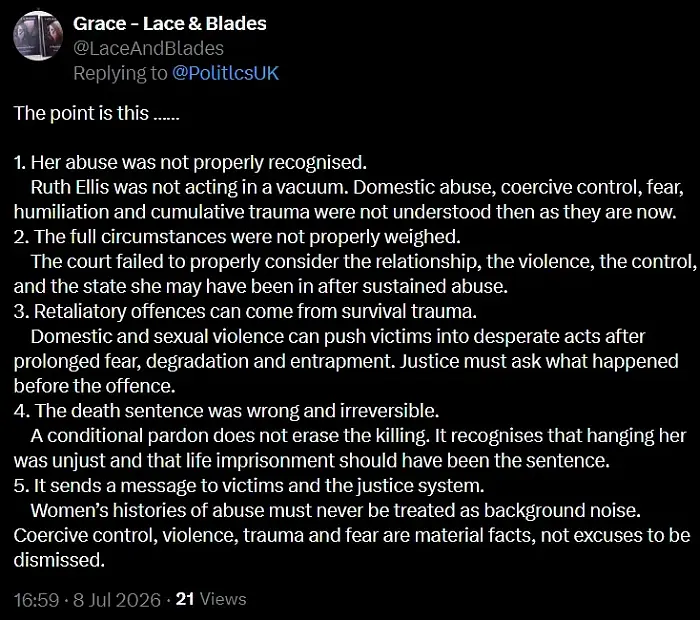
An exposition of the circumstances surrounding Ells’ plight – including the failures re the domestic violence and male coercion, plus the trauma which resulted in the shooting. Twitter/X.
Even though Ruth Ellis shot her partner in what was an act of desperation against the abuse she had received, the whole matter became one of her being a murderess. It was not one of her having acted in a fit of desperation at the abuse she had received. In the eyes of the law she was a murderer, as simple as that. The sheer dissonance which the police and the legal justice system played in this matter made doubly sure Ellis was the problem, not Blakely, and for that, she had to hang.
This is why the post-houmous pardon, even though its something that ought to have been done a long time ago, still, in a sense, does not pardon Ellis (nor does it excuse the miserable gamut of domestic violence that’s pervaded women for so long) and that because its a life sentence rather and it also has ignored the countless women who have suffered before and since. Even nowadays we can see how policing is still substantially skewered towards a disbelief of any domestic violence having been enacted. Its somewhat better now yet undoubtedly there’s no doubt gross injustices still occur. Even in terms of rape many women were unable to report such violations – and that because they thought they would not be believed. Some things never change.
In general terms, legislation on violence against women has existed since 1853 (such as Act for the Better Prevention and Punishment of aggravated assaults upon women and children of 1853, and Offences Against the Person Act of 1861). However there are many inconsistencies – too many to list here – so the more important legislation is highlighted as follows. There was the Rule of Thumb law of 1857 which stipulated a man could beat his wife as long as ‘a rod not thicker than his thumb’ be used. In 1860 the Law of Coverture stipulated that a husband was legally responsible for his wife and children – and by that means the husband was entitled to use physical or verbal abuse to control any behavior in the family.
One can see how this worked. Yes there was legislation that stipulated the prohibition of violence against the person, but in terms of patriarchy the male doubtless owned the woman (and children) so that was altogether a different thing. Essentially the law gave with one hand and took away with the other – and those being protected were husbands. Wife beating simply could not cease and that because the men were ennobled by the law. Human Idiocy highlighted some of this violence in an earlier post – To be or knot to be? A prevalent history.
In that time during the mid 19th century too, a married woman’s property became that of her husband’s. After 1870 it changed somewhat so that anything a married woman earned or inherited became hers instead. One can describe that as a fudge however because it was tokenistic – it looked good but it didn’t exactly give the wife full control of her own financial situations.
In 1895 a law in London was passed on wife beating. Sadly that did not have the express aim of ending that unsavoury practice. Rather it stipulated that between 10pm and 7am men should not beat their wives – the reason being this nocturnal activity kept people awake. Clearly the night hours were when women were at their most vulnerable – for they had to share their bedroom with the husbands. One can see from legislation such as this that domestic violence was expressively permitted so it couldn’t have been any sort of crime even. Basically it encouraged people to look the other way and countless numbers of women would have been disaffected by this law. Clearly the law was in favour of men, but stacked against women – and this state of affairs basically lasted until the 1970s when things began to change.
The quest to define domestic violence and procure legislation to prevent such horrors did not gain any legislation until 1976. This was when the Domestic Violence and Matrimonial Proceedings Act got passed. That was a step change in recognising that violence wasn’t just about the person but also various forms of control and abuse, often resulting in violence against the person too. Even so the uptake in the awareness of domestic violence and its social implications were slow. That is until the 1990s when martial rape was criminalised and the prevention of violence against women and children was was recognised as part of human rights. Despite all that in quite a number of situations the husband is still deemed to be the owner of a woman and her offspring.
Its clear from the above that the justice system has basically been primed against women and practically allowed men to act with impunity. It is evident the Home Secretary and the Ministry of Justice have not fully appreciated the situation – although they have gone some way to explaining how the system had given victims of domestic violence such a miss. It is a pretty poor explanation however, and undoubtedly shows that little thought has actually been given as to the seriousness of the situation. A quashed conviction would have been the way to go for it would have acknowledged the complete fallibility of the justice system.
The entire justice system is replete with such matters that make it almost an idiotic endeavour. Many might think policing and the legal system represents the best means at solving crime and misdemeanour, but often it works against the grain and invariably it only changes when things are too late – that is when enormous injustices have inevitably been carried out.
When people claim the law is an ass, there’s no doubt they see it for what it really is – a cabal of stupidity.